


Buy Kratom Extract, Powder & Capsules Online






















Green Borneo Kratom — Effects, Character & Where to Buy
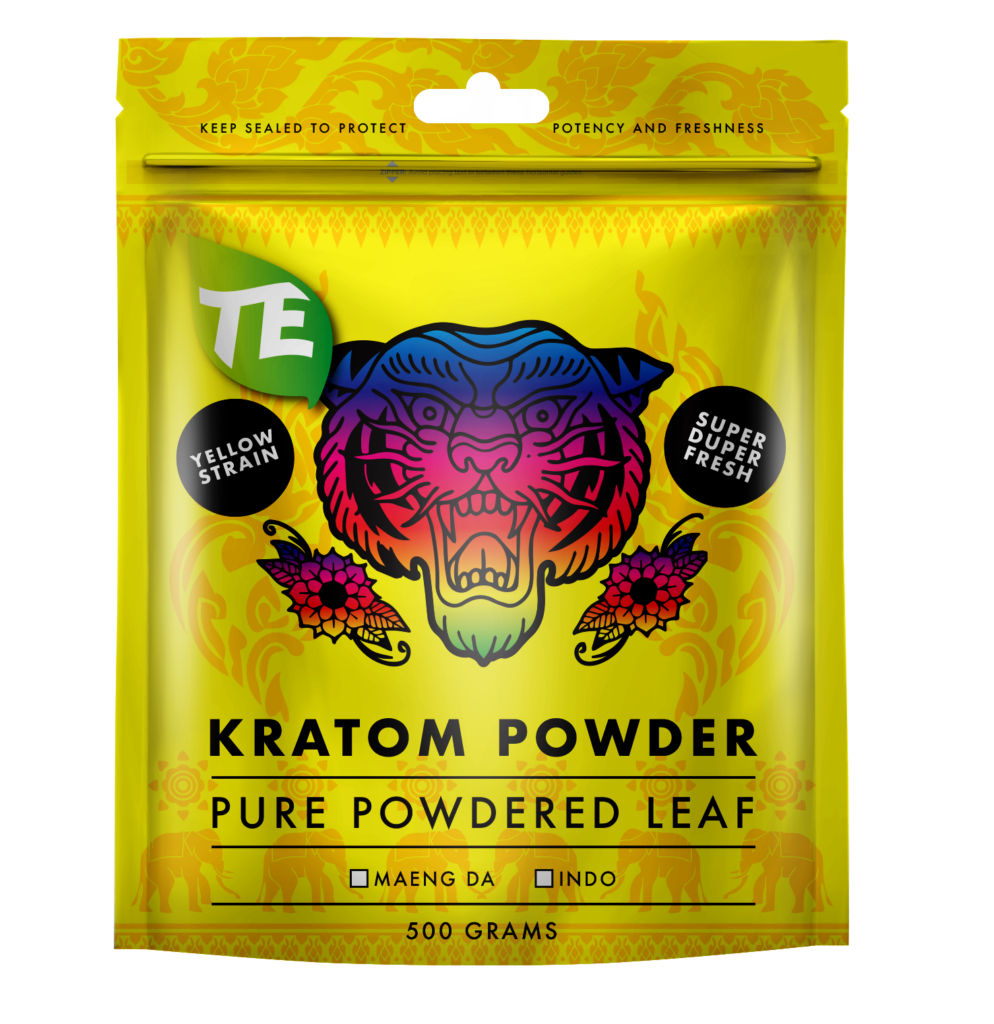
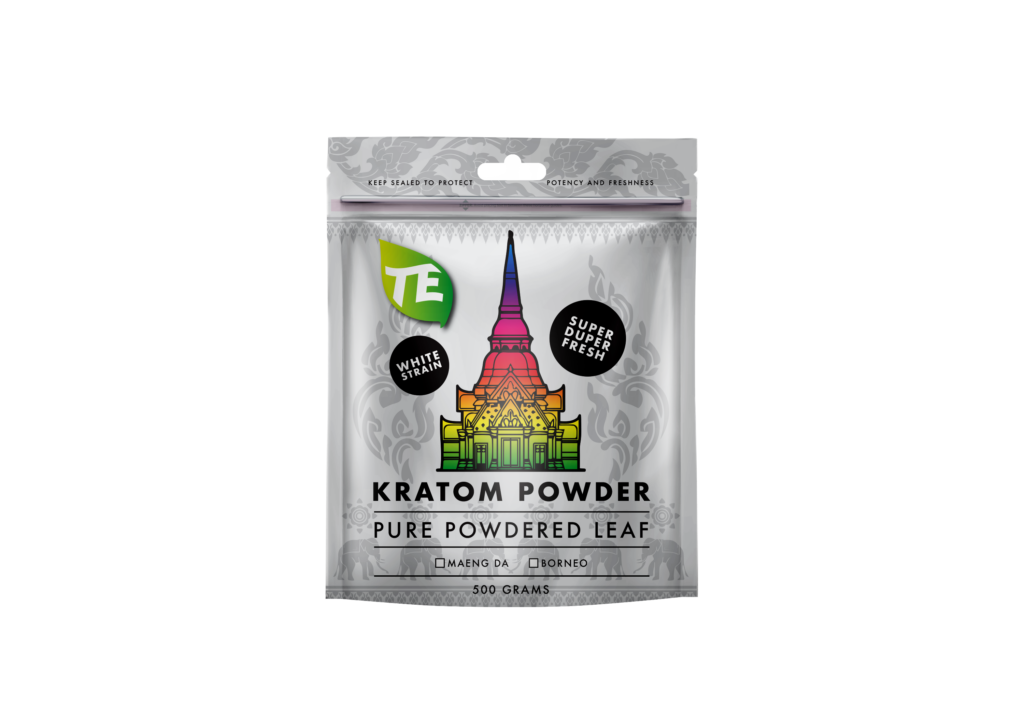
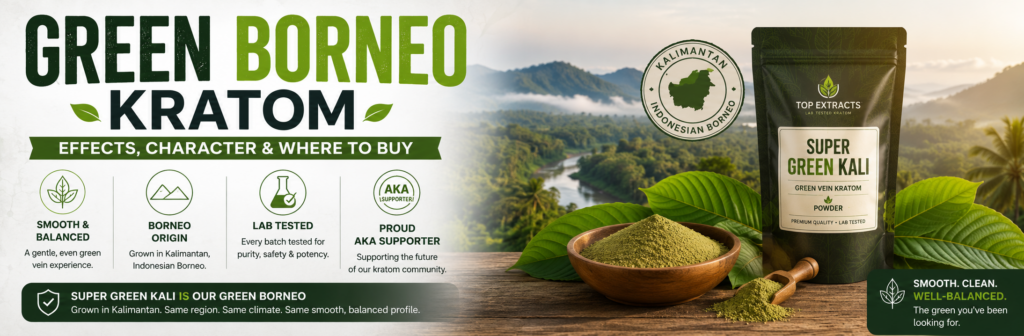
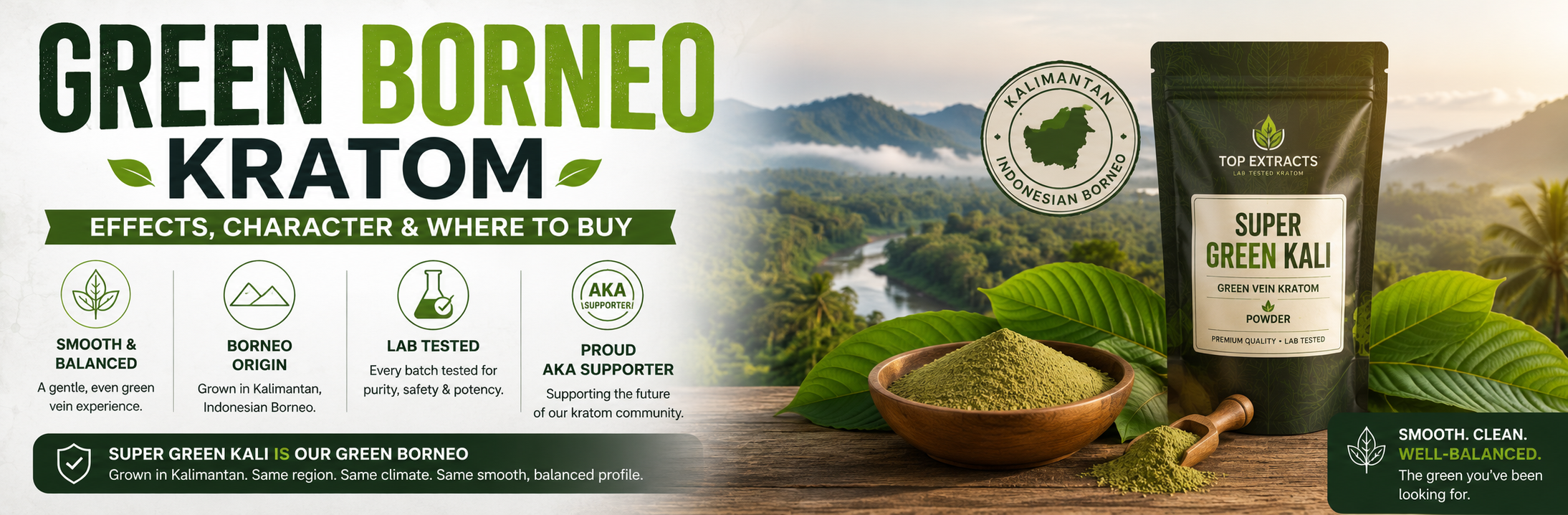
Green Borneo kratom is a smooth, balanced green vein strain grown in the Borneo region of Indonesia — gentler than a white, lighter than a red. Green Borneo is named after the region where it’s grown rather than a single standardized cultivar. Here’s the useful part if you’re shopping: Borneo’s Indonesian side is called Kalimantan, and our Super Green Kali is grown right there — so it’s a true Borneo-region green vein. Below is how Green Borneo fits among green strains, and which of ours lines up with it.
📋 Table of Contents
What Is Green Borneo Kratom?
Green Borneo kratom is a green vein strain from the Borneo island region — specifically Kalimantan, the Indonesian side of Borneo. The “green” refers to the vein colour of the leaf at harvest, which sits between the brighter whites and the deeper reds. Borneo green vein is typically described as balanced and easygoing, which is why it comes up so often as a starting point for people new to green strains. It grows in humid, tropical conditions on small farms across the region.
Green Borneo Kratom Character & Profile
Green Borneo kratom is usually described by customers as smooth, clean, and well-balanced. Commonly, customers describe:
- A gentle, even character without a harsh edge
- A clear, level feel through the day
- A rounded green-vein profile
- A softer onset than stronger white strains
Everyone responds differently depending on individual body chemistry, serving size, and tolerance. These products are not intended to diagnose, treat, cure, or prevent any disease.
Green Borneo vs Our Green Strains
So which of our greens is the Green Borneo you’re looking for? Here’s how our two green strains line up.
| Our Green Strain | Also Known As | Character | Good Match For |
|---|---|---|---|
| Super Green Kali | Our Green Borneo — same Kalimantan (Borneo) region | Smooth, balanced green vein | Easygoing all-day green |
| Green Maeng Da | Blend of greens, farmers’ choice grade | Bold, brisk green | A more assertive green |
If you came looking for Green Borneo, our Super Green Kali is sourced from the same Kalimantan region of Borneo and reflects the smooth, balanced profile people associate with Green Borneo. We just carry it under our own name. Want a more assertive option? Compare our full range of green kratom strains, or try a sample pack to find your fit.
Green Borneo Kratom Serving Guidance
FAQ — Green Borneo Kratom
Related: lab results page · kratom dosage guide · green kratom strains.
Shop Our Kalimantan-Grown Green
Top Extracts has been sourcing kratom since 2013, with roots in relationships built with small Kalimantan farmers, and we’re a proud supporter of the American Kratom Association. Every batch is lab-tested before it ships. Green Borneo is a strain we source — we carry it as Super Green Kali. If that’s what brought you here, it’s the green to try:
- Shop Super Green Kali Kratom Powder
- Shop Super Green Kali Kratom Capsules
- Explore all green kratom strains
📋 Table of Contents
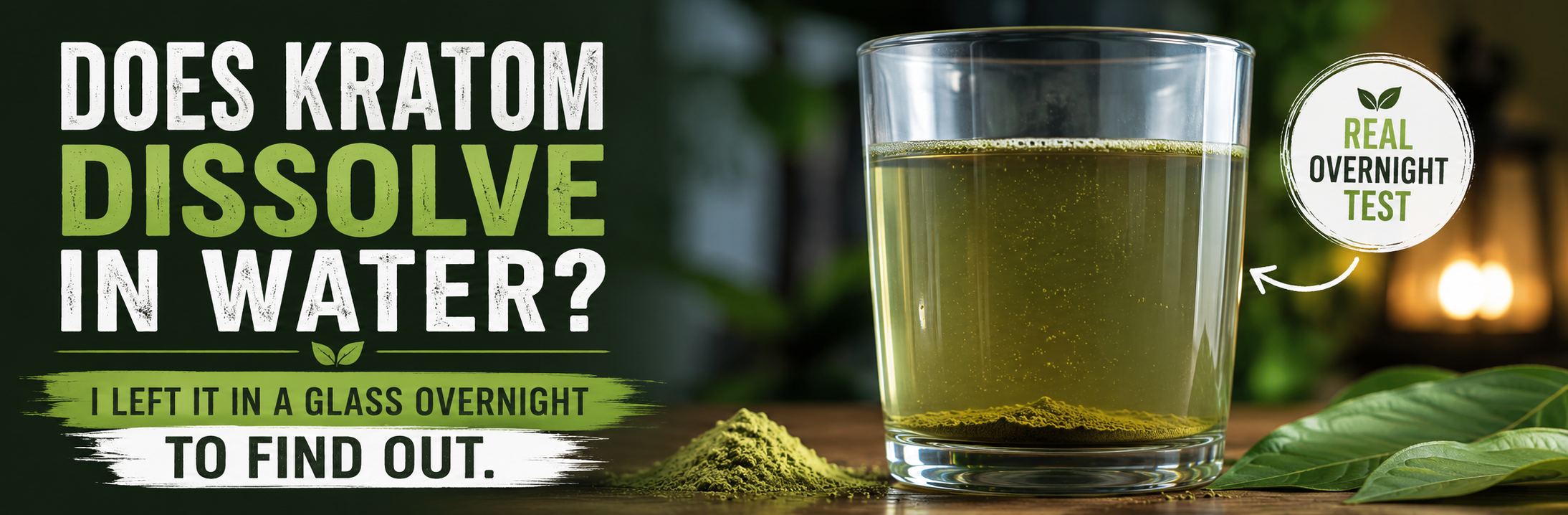
“Does kratom dissolve in water?” comes up constantly. If you’d rather drink your kratom than do the dry toss-and-wash — powder in the mouth, water to chase it down — a powder that just dissolved into a clean drink would be ideal. So people ask, and the answers online are all over the place: some say it dissolves in warm water, some say it never does, some say to let it sit, some say just stir and slam it.
The honest answer is no, kratom doesn’t dissolve — it’s plant matter, so it behaves more like coffee grounds than like sugar or salt. What it actually does is form a suspension: the powder spreads through the water for a while, then separates back out. But “it forms a suspension” is easy to say and hard to picture, so I just watched it happen. I used our Super Green Kali kratom powder, a clear beaker, and plain water, and photographed it from the moment it hit the water through the next day. Here’s the whole thing, start to finish.
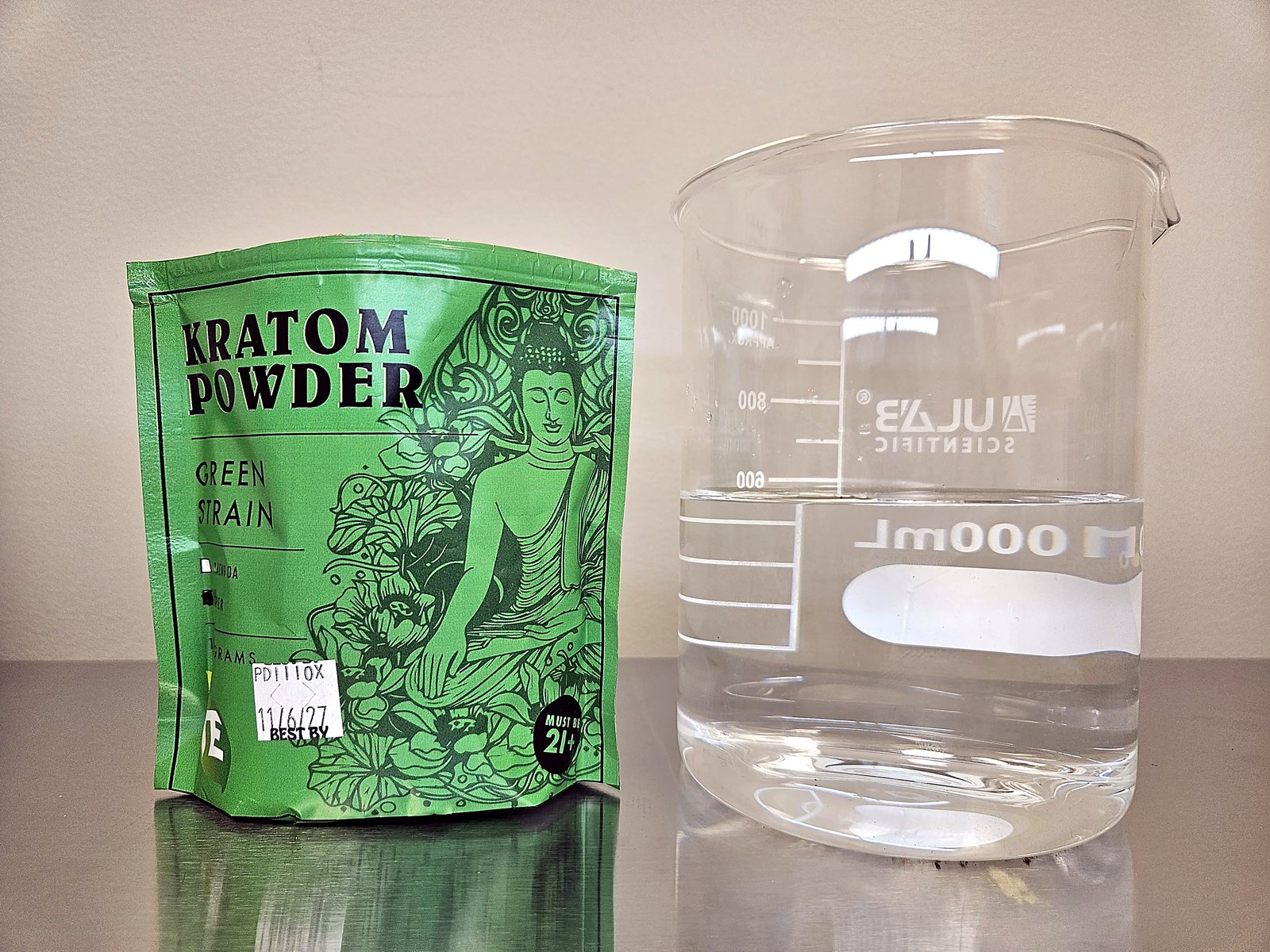
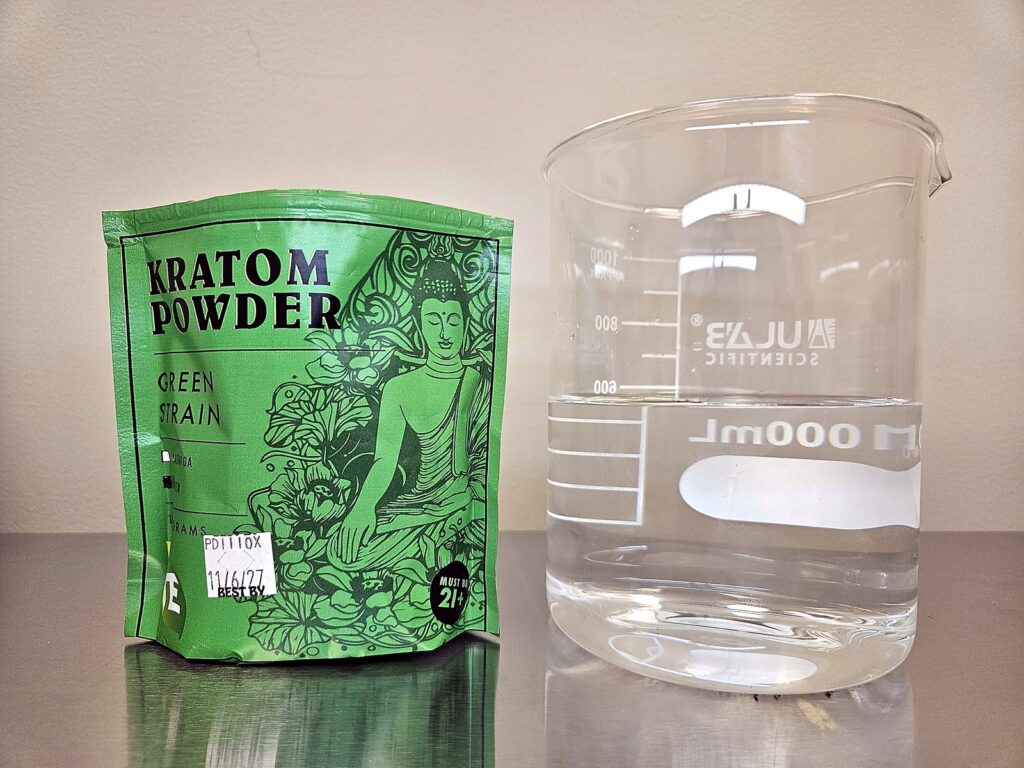
Clear glass of water beside a sealed green kratom powder pouch, before mixing.
The Starting Point
Clear water, fresh pouch. Nothing added yet — this is the baseline so the color change later is obvious.
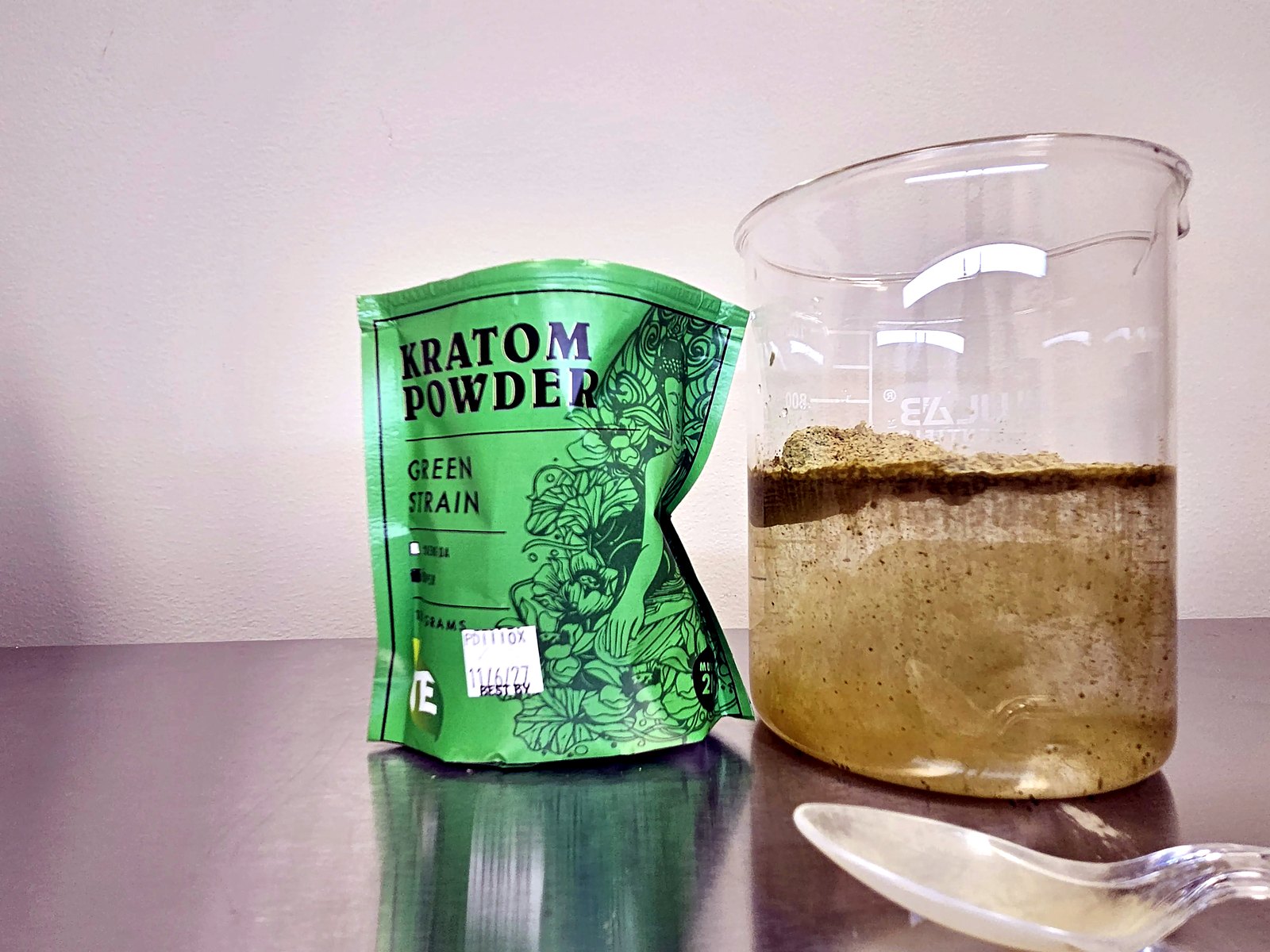
Green kratom powder floating as a dry raft on the surface of clear water.
First Contact: It Floats, Briefly
Two heaping spoonfuls in, and at first the powder just sits on the surface as a dry raft. The water underneath is still clear. This is the moment people see when they ask whether kratom floats — yes, for a few seconds it does.
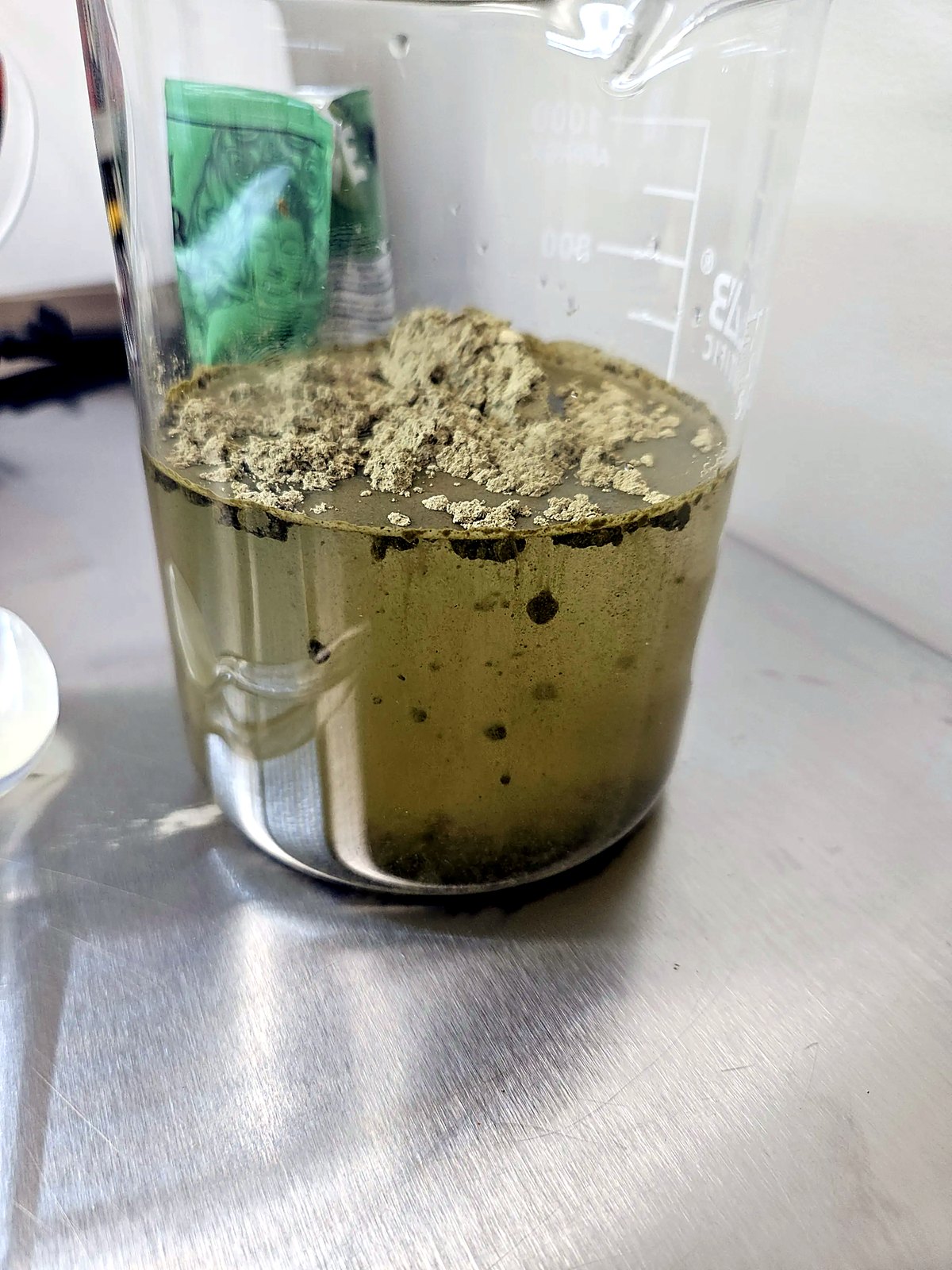
Kratom powder breaking apart and sinking in clumps, clouding the water olive-green within minutes.
Within Minutes: It Sinks and Clumps
It doesn’t stay on top for long. Within a few minutes the raft breaks and the powder drops in clumps, and the water starts going cloudy and olive as the fine particles spread. This is the suspension everyone online describes — the powder is distributed through the water, not dissolved into it, the same way coffee grounds cloud water without ever disappearing. By the five-minute mark both spoonfuls were on the bottom.
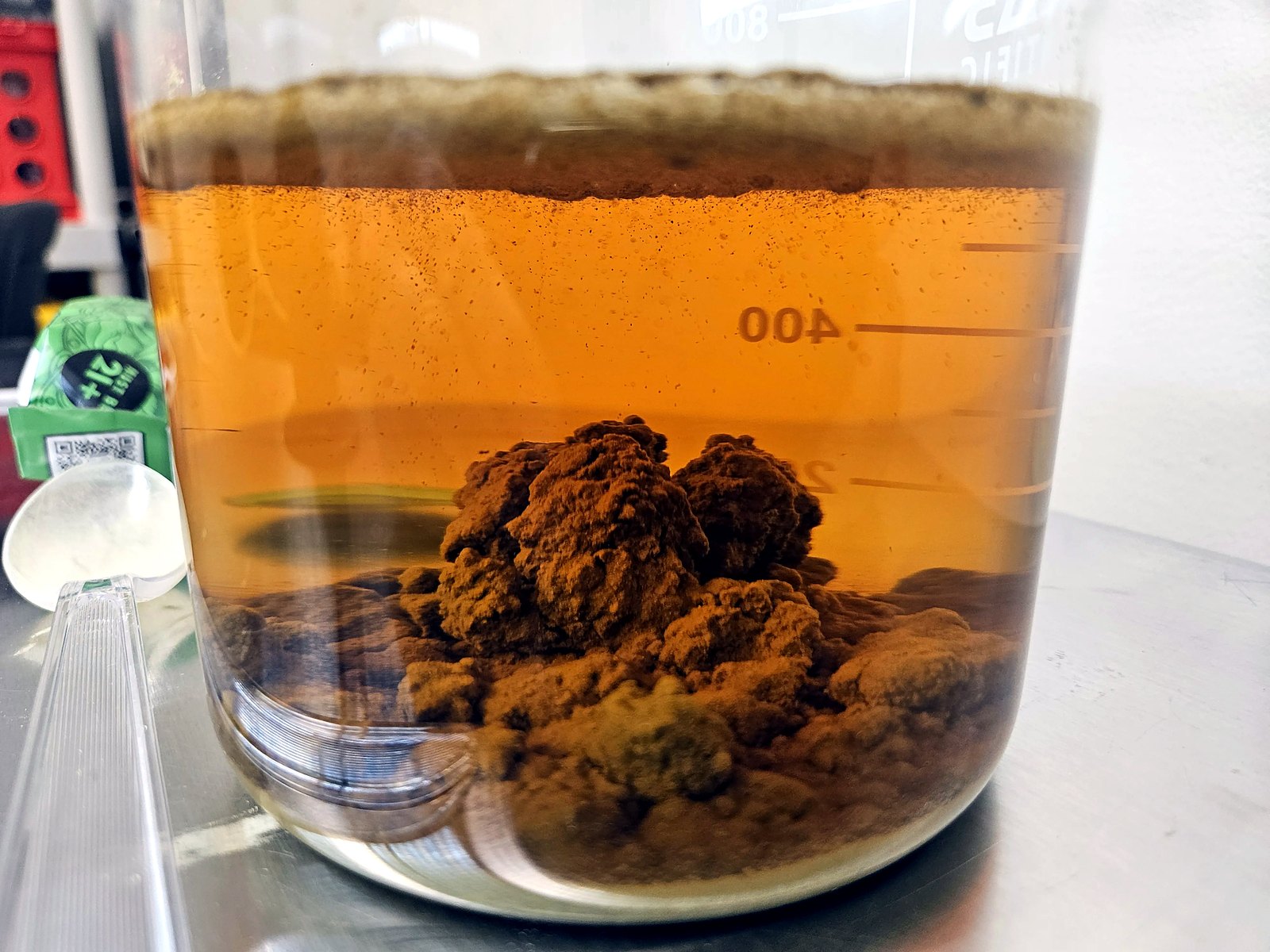
After sitting overnight, kratom powder settled into a rocky clumped bed at the bottom with clear amber liquid above.
Overnight, Undisturbed: It Settles Hard
This is the part that answers the dissolve question for good. Left alone overnight, everything dropped out. The powder consolidated into a dense, rocky bed at the bottom — not a smooth even layer, but clumped mounds — with a thin skin of fines caked at the waterline. And the water above it went clear again: a deep reddish-amber, like tea. If kratom dissolved, the powder would be gone and the liquid would stay uniform. Instead it’s all sitting at the bottom. What colored the water is the soluble material leaching out of the leaf overnight; the powder itself never dissolved — it just settled.
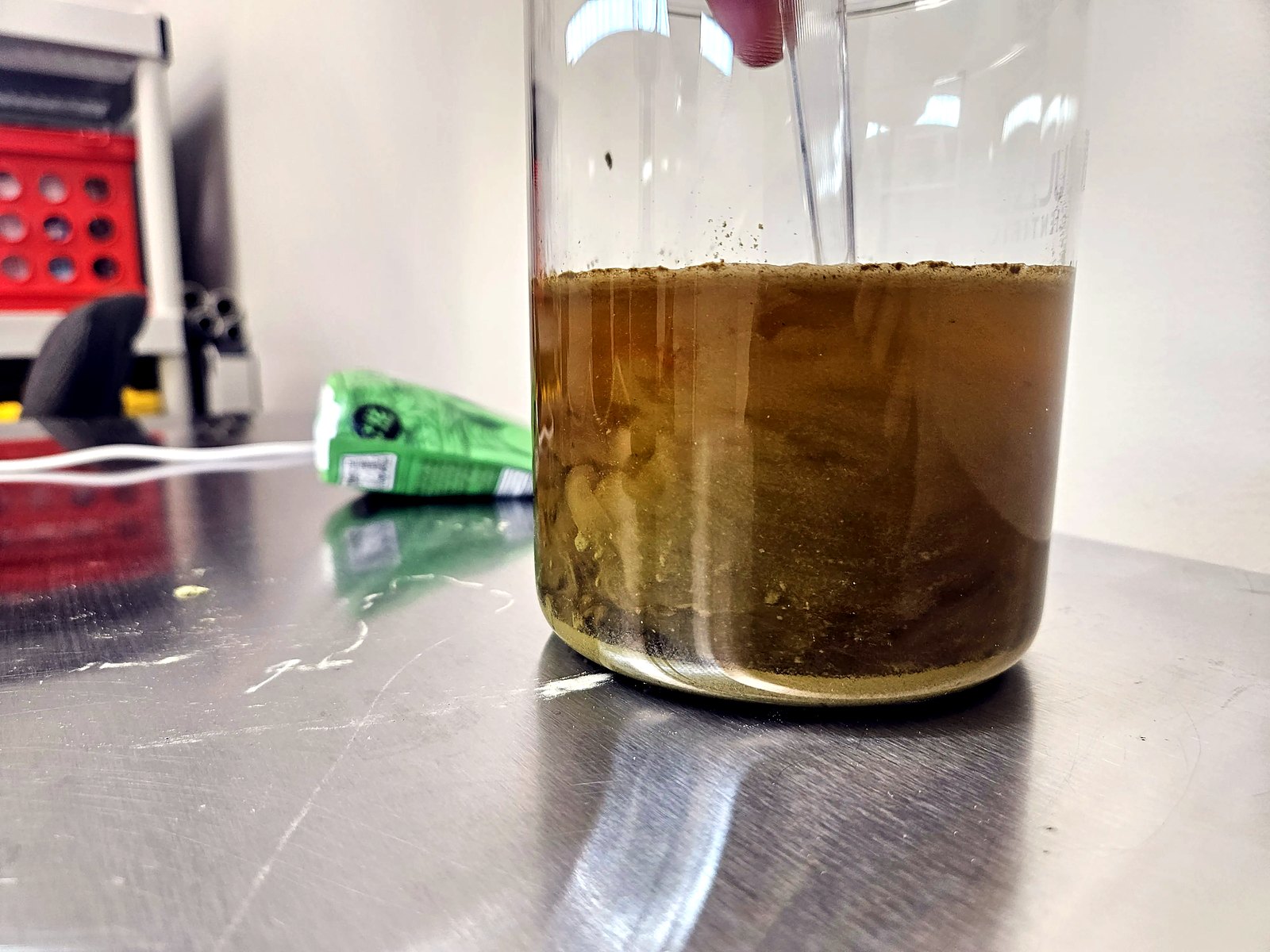
Stirred kratom re-clouding the water into a thin, silky suspension, with gritty texture visible on the spoon.
One Stir Brings It All Back
Give it a stir and the settled bed lifts instantly. The clear amber goes fully cloudy again, and on the spoon you can see what you’re working with: a thin, broken-up, slightly gritty suspension. Soft and silky-looking, drinkable — but still clearly powder in water, not a clean dissolved liquid.
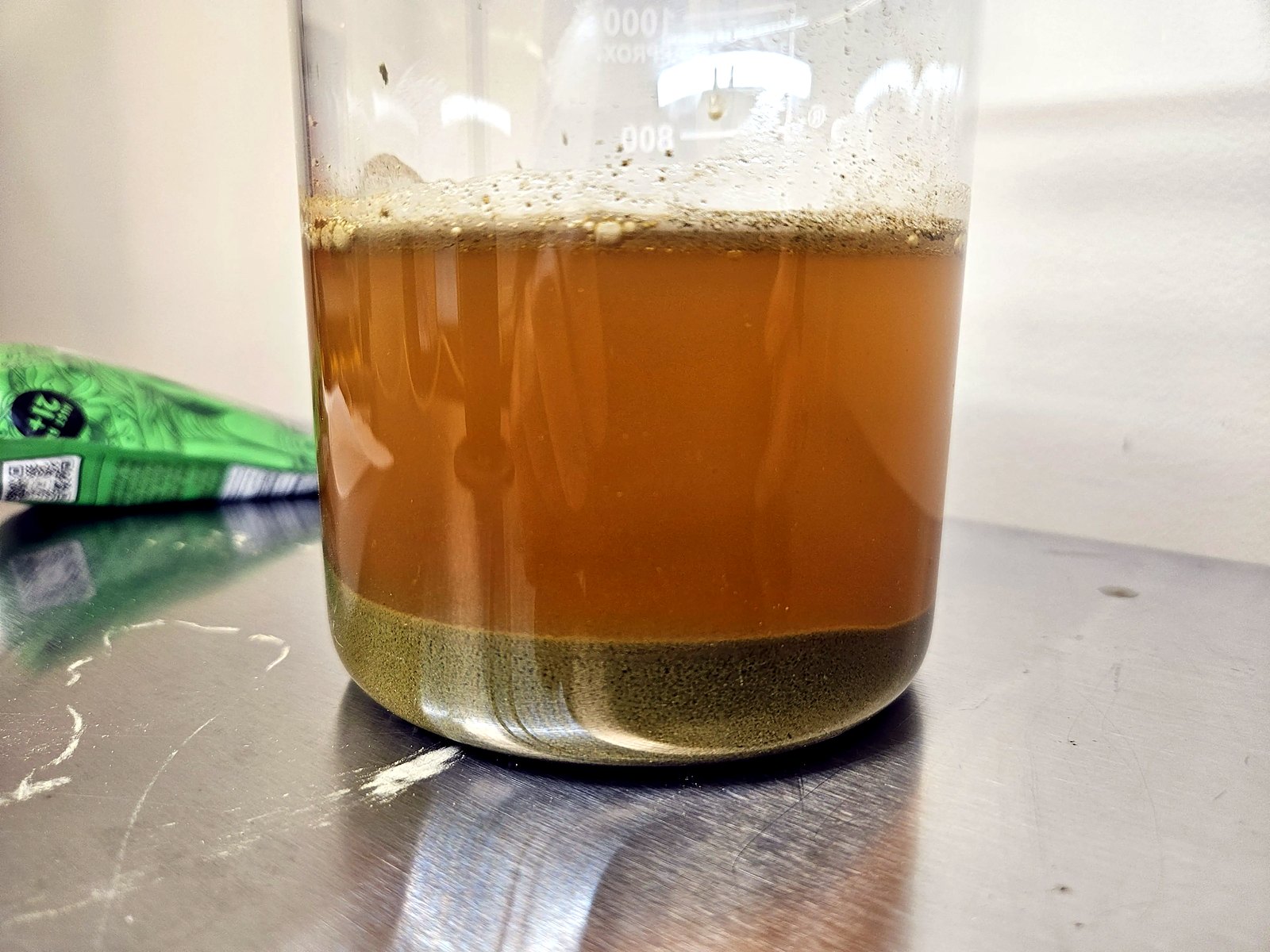
One hour after stirring, the kratom has settled again into a green bed beneath reddish-amber liquid.
An Hour Later: It Settles Again
And here’s what seals it. An hour after stirring, it had settled right back out — an even green bed on the bottom, reddish-amber liquid above. Same behavior as the five-minute mark, just with colored water now. This is the cycle people describe online: stir it, drink it before it drops, and if you stop, it settles to the bottom again. It never dissolves. It wets, sinks, clumps, colors the water, and re-suspends only for as long as you keep it moving — then it drops back down.
So If It Won’t Dissolve, What’s the Best Way to Take It?
Since it won’t dissolve, every method is really just a way of dealing with that. Toss-and-wash is popular because it’s fast — you skip the glass entirely — but it means dry powder in your mouth, which plenty of people would rather avoid.
Mixing it into water is the other common route, and this test shows what that actually involves: you’re making a suspension, so you stir it, drink it reasonably quickly, and give it another stir if it starts to settle. If you’re willing to wait — or make a batch ahead of time — the powder wets fully and a quick stir gives you that soft, silky liquid you can sip. Neither method is “better”; toss-and-wash is the no-wait option, and mixing or prepping ahead is the option for people who’d rather drink it than put dry powder in their mouth. Two real choices, depending on whether you’ve got the time.
And if you’d rather skip the glass, the spoon, the grit, and the stirring altogether, that’s exactly what pre-measured Super Green Kali capsules are for — same Super Green Kali, none of the mixing. It’s also worth knowing that how you store your kratom affects how cleanly it behaves when you do mix it, since clumping and moisture change how the powder wets and settles.
People Think Their Kratom Is “Magnetic.” I Tested Ours With a Plastic Spoon.
super-green-kali-plastic-spoon-static-test
📋 Table of Contents
Search kratom forums and you’ll find the same photo over and over: powder coming out of a plastic pouch, spiking up off the spoon in fuzzy little points, reaching like it’s alive. The caption is almost always the same three words — “should I be concerned?” — usually followed by “Is this metal? Should I run a magnet over it?”
It’s a fair thing to wonder. But the answer in those threads — from the people who actually know — is consistent: it’s static electricity, and it’s harmless. Two things worth knowing before you reach for a magnet:
- A magnet test proves nothing. A statically charged powder won’t respond to a magnet at all. And lead — the contaminant people are usually worried about — isn’t magnetic either. So the magnet trick can’t confirm or clear anything.
- The real variable is dry air. The most grounded comments all point the same way: it shows up in winter when the heater’s running, and it can be reproduced year to year based on how dry the room is. Fine, dry powder picks up a charge — same reason coffee grounds jump around a plastic grinder. Plastic is a poor conductor, so the charge doesn’t bleed off, and the powder spikes.
So I wanted to see what our Super Green Kali kratom powder did in the exact setup where people catch this — a clear plastic spoon, fresh pouch, daylight. I opened the pouch, dipped the clear spoon, and stirred.
No spikes. The spoon came out with a fine dust film — this powder is very finely milled, so a little coating is expected — and the powder gathered into a clump in one corner on the back of the spoon, with a couple of small stuck pockets. But the spiking everyone photographs — the fuzzy little points reaching off the spoon, the cloud you can’t control — didn’t happen.
I ran it again with a metal spoon (off-camera) to check whether the plastic was the variable. Same result. Fine film, a corner clump, no static show on either spoon.
I’m not going to claim ours can’t ever do it — static is about the air in your room as much as the powder, and a bone-dry winter might tell a different story. What I can say is that pouch-to-spoon, plastic or metal, this batch stayed put.
One honest takeaway either way: that corner-clumping is exactly why a scoop weighs differently depending on how the powder settles — which is also why how you store your kratom matters more than people think — and it’s one reason a lot of people skip the spoon entirely and reach for pre-measured Super Green Kali capsules instead. Same Super Green Kali, no spoon, no film, no guessing, no magnet panic.
Green Borneo Kratom — Effects, Character & Where to Buy
Green Borneo kratom is a smooth, balanced green vein strain grown in the Borneo region of Indonesia — gentler than a white, lighter than a red. Green Borneo is named after the region where it’s grown rather than a single standardized cultivar. Here’s the useful part if you’re shopping: Borneo’s Indonesian side is called Kalimantan, and our Super Green Kali is grown right there — so it’s a true Borneo-region green vein. Below is how Green Borneo fits among green strains, and which of ours lines up with it.
📋 Table of Contents
What Is Green Borneo Kratom?
Green Borneo kratom is a green vein strain from the Borneo island region — specifically Kalimantan, the Indonesian side of Borneo. The “green” refers to the vein colour of the leaf at harvest, which sits between the brighter whites and the deeper reds. Borneo green vein is typically described as balanced and easygoing, which is why it comes up so often as a starting point for people new to green strains. It grows in humid, tropical conditions on small farms across the region.
Green Borneo Kratom Character & Profile
Green Borneo kratom is usually described by customers as smooth, clean, and well-balanced. Commonly, customers describe:
- A gentle, even character without a harsh edge
- A clear, level feel through the day
- A rounded green-vein profile
- A softer onset than stronger white strains
Everyone responds differently depending on individual body chemistry, serving size, and tolerance. These products are not intended to diagnose, treat, cure, or prevent any disease.
Green Borneo vs Our Green Strains
So which of our greens is the Green Borneo you’re looking for? Here’s how our two green strains line up.
| Our Green Strain | Also Known As | Character | Good Match For |
|---|---|---|---|
| Super Green Kali | Our Green Borneo — same Kalimantan (Borneo) region | Smooth, balanced green vein | Easygoing all-day green |
| Green Maeng Da | Blend of greens, farmers’ choice grade | Bold, brisk green | A more assertive green |
If you came looking for Green Borneo, our Super Green Kali is sourced from the same Kalimantan region of Borneo and reflects the smooth, balanced profile people associate with Green Borneo. We just carry it under our own name. Want a more assertive option? Compare our full range of green kratom strains, or try a sample pack to find your fit.
Green Borneo Kratom Serving Guidance
FAQ — Green Borneo Kratom
Related: lab results page · kratom dosage guide · green kratom strains.
Shop Our Kalimantan-Grown Green
Top Extracts has been sourcing kratom since 2013, with roots in relationships built with small Kalimantan farmers, and we’re a proud supporter of the American Kratom Association. Every batch is lab-tested before it ships. Green Borneo is a strain we source — we carry it as Super Green Kali. If that’s what brought you here, it’s the green to try:
- Shop Super Green Kali Kratom Powder
- Shop Super Green Kali Kratom Capsules
- Explore all green kratom strains
📋 Table of Contents
“Does kratom dissolve in water?” comes up constantly. If you’d rather drink your kratom than do the dry toss-and-wash — powder in the mouth, water to chase it down — a powder that just dissolved into a clean drink would be ideal. So people ask, and the answers online are all over the place: some say it dissolves in warm water, some say it never does, some say to let it sit, some say just stir and slam it.
The honest answer is no, kratom doesn’t dissolve — it’s plant matter, so it behaves more like coffee grounds than like sugar or salt. What it actually does is form a suspension: the powder spreads through the water for a while, then separates back out. But “it forms a suspension” is easy to say and hard to picture, so I just watched it happen. I used our Super Green Kali kratom powder, a clear beaker, and plain water, and photographed it from the moment it hit the water through the next day. Here’s the whole thing, start to finish.
Clear glass of water beside a sealed green kratom powder pouch, before mixing.
The Starting Point
Clear water, fresh pouch. Nothing added yet — this is the baseline so the color change later is obvious.
Green kratom powder floating as a dry raft on the surface of clear water.
First Contact: It Floats, Briefly
Two heaping spoonfuls in, and at first the powder just sits on the surface as a dry raft. The water underneath is still clear. This is the moment people see when they ask whether kratom floats — yes, for a few seconds it does.
Kratom powder breaking apart and sinking in clumps, clouding the water olive-green within minutes.
Within Minutes: It Sinks and Clumps
It doesn’t stay on top for long. Within a few minutes the raft breaks and the powder drops in clumps, and the water starts going cloudy and olive as the fine particles spread. This is the suspension everyone online describes — the powder is distributed through the water, not dissolved into it, the same way coffee grounds cloud water without ever disappearing. By the five-minute mark both spoonfuls were on the bottom.
After sitting overnight, kratom powder settled into a rocky clumped bed at the bottom with clear amber liquid above.
Overnight, Undisturbed: It Settles Hard
This is the part that answers the dissolve question for good. Left alone overnight, everything dropped out. The powder consolidated into a dense, rocky bed at the bottom — not a smooth even layer, but clumped mounds — with a thin skin of fines caked at the waterline. And the water above it went clear again: a deep reddish-amber, like tea. If kratom dissolved, the powder would be gone and the liquid would stay uniform. Instead it’s all sitting at the bottom. What colored the water is the soluble material leaching out of the leaf overnight; the powder itself never dissolved — it just settled.
Stirred kratom re-clouding the water into a thin, silky suspension, with gritty texture visible on the spoon.
One Stir Brings It All Back
Give it a stir and the settled bed lifts instantly. The clear amber goes fully cloudy again, and on the spoon you can see what you’re working with: a thin, broken-up, slightly gritty suspension. Soft and silky-looking, drinkable — but still clearly powder in water, not a clean dissolved liquid.
One hour after stirring, the kratom has settled again into a green bed beneath reddish-amber liquid.
An Hour Later: It Settles Again
And here’s what seals it. An hour after stirring, it had settled right back out — an even green bed on the bottom, reddish-amber liquid above. Same behavior as the five-minute mark, just with colored water now. This is the cycle people describe online: stir it, drink it before it drops, and if you stop, it settles to the bottom again. It never dissolves. It wets, sinks, clumps, colors the water, and re-suspends only for as long as you keep it moving — then it drops back down.
So If It Won’t Dissolve, What’s the Best Way to Take It?
Since it won’t dissolve, every method is really just a way of dealing with that. Toss-and-wash is popular because it’s fast — you skip the glass entirely — but it means dry powder in your mouth, which plenty of people would rather avoid.
Mixing it into water is the other common route, and this test shows what that actually involves: you’re making a suspension, so you stir it, drink it reasonably quickly, and give it another stir if it starts to settle. If you’re willing to wait — or make a batch ahead of time — the powder wets fully and a quick stir gives you that soft, silky liquid you can sip. Neither method is “better”; toss-and-wash is the no-wait option, and mixing or prepping ahead is the option for people who’d rather drink it than put dry powder in their mouth. Two real choices, depending on whether you’ve got the time.
And if you’d rather skip the glass, the spoon, the grit, and the stirring altogether, that’s exactly what pre-measured Super Green Kali capsules are for — same Super Green Kali, none of the mixing. It’s also worth knowing that how you store your kratom affects how cleanly it behaves when you do mix it, since clumping and moisture change how the powder wets and settles.
People Think Their Kratom Is “Magnetic.” I Tested Ours With a Plastic Spoon.
super-green-kali-plastic-spoon-static-test
📋 Table of Contents
Search kratom forums and you’ll find the same photo over and over: powder coming out of a plastic pouch, spiking up off the spoon in fuzzy little points, reaching like it’s alive. The caption is almost always the same three words — “should I be concerned?” — usually followed by “Is this metal? Should I run a magnet over it?”
It’s a fair thing to wonder. But the answer in those threads — from the people who actually know — is consistent: it’s static electricity, and it’s harmless. Two things worth knowing before you reach for a magnet:
- A magnet test proves nothing. A statically charged powder won’t respond to a magnet at all. And lead — the contaminant people are usually worried about — isn’t magnetic either. So the magnet trick can’t confirm or clear anything.
- The real variable is dry air. The most grounded comments all point the same way: it shows up in winter when the heater’s running, and it can be reproduced year to year based on how dry the room is. Fine, dry powder picks up a charge — same reason coffee grounds jump around a plastic grinder. Plastic is a poor conductor, so the charge doesn’t bleed off, and the powder spikes.
So I wanted to see what our Super Green Kali kratom powder did in the exact setup where people catch this — a clear plastic spoon, fresh pouch, daylight. I opened the pouch, dipped the clear spoon, and stirred.
No spikes. The spoon came out with a fine dust film — this powder is very finely milled, so a little coating is expected — and the powder gathered into a clump in one corner on the back of the spoon, with a couple of small stuck pockets. But the spiking everyone photographs — the fuzzy little points reaching off the spoon, the cloud you can’t control — didn’t happen.
I ran it again with a metal spoon (off-camera) to check whether the plastic was the variable. Same result. Fine film, a corner clump, no static show on either spoon.
I’m not going to claim ours can’t ever do it — static is about the air in your room as much as the powder, and a bone-dry winter might tell a different story. What I can say is that pouch-to-spoon, plastic or metal, this batch stayed put.
One honest takeaway either way: that corner-clumping is exactly why a scoop weighs differently depending on how the powder settles — which is also why how you store your kratom matters more than people think — and it’s one reason a lot of people skip the spoon entirely and reach for pre-measured Super Green Kali capsules instead. Same Super Green Kali, no spoon, no film, no guessing, no magnet panic.

WHAT IS
KRATOM?
Kratom is a leaf hailing primarily from Southeast Asia that is closely related in chemical makeup to the coffee plant, it is mainly consumed in powder or capsule form. To date Kratom is used by and estimated 15 million Americans who are seeking natural alternatives to improve their health and wellness.

Who BENEFITS FROM TAKING KRATOM?
The people who benefit from Kratom the most are those that are looking to looking to increase energy levels, boost moods, and who are seeking comfort from everyday aches and pains.

GET COZY WITH AN EASY
KRATOM TEA
Heat 2-4 cups of water at a slow boil, place the powder or crushed leaf in the pot and let it simmer for 20 minutes. Allow it to cool down, add lemon and/or honey if desired and enjoy. Tea can be enjoyed strained or unstrained. Check out our blog page for more tips and recipes!
 Do you ship worldwide?
We currently ship within the United States only. We use USPS, FedEx, and UPS to deliver your order fast and reliably.
How long before orders are shipped?We ship Monday–Friday. Most orders ship within 1 business day. If there’s any issue with your order, we’ll reach out to you at the email address on your account.
What type of accounts do you accept?We accept retail, wholesale, online, and manufacturing companies into our wholesale program.
What type of packaging / labeling do you use?We ship discreetly — no company branding on the outside of the package. We use USPS flat rate packaging with only a PO box as the return address. Your privacy is protected.
Kratom is legal in most U.S. states. A few states and counties have local restrictions. We recommend checking your local laws before ordering. We cannot ship to areas where kratom is banned.
Red kratom is known for relaxation and comfort. Green is a middle ground — mild energy with a calming effect. White is the most energizing strain, popular for focus and productivity.
Yes. All Top Extracts products are third-party lab tested for purity and potency. You can view our COAs on our Kratom Lab Testing page.
Most orders ship within 1 business day Monday–Friday. Standard delivery typically arrives in 3-5 business days. Expedited options are available at checkout.